
Online Checkweigher Dynamic Weighing · Automatic Weight Assessment · Reject Handling
Designed for continuous weight inspection on food and industrial production lines. Products are dynamically weighed in motion and assessed against configured limits as acceptable, overweight or underweight, with optional alarms, automatic rejection and production data recording.
Request an Equipment Proposal View Technical Specifications Open Selection Guide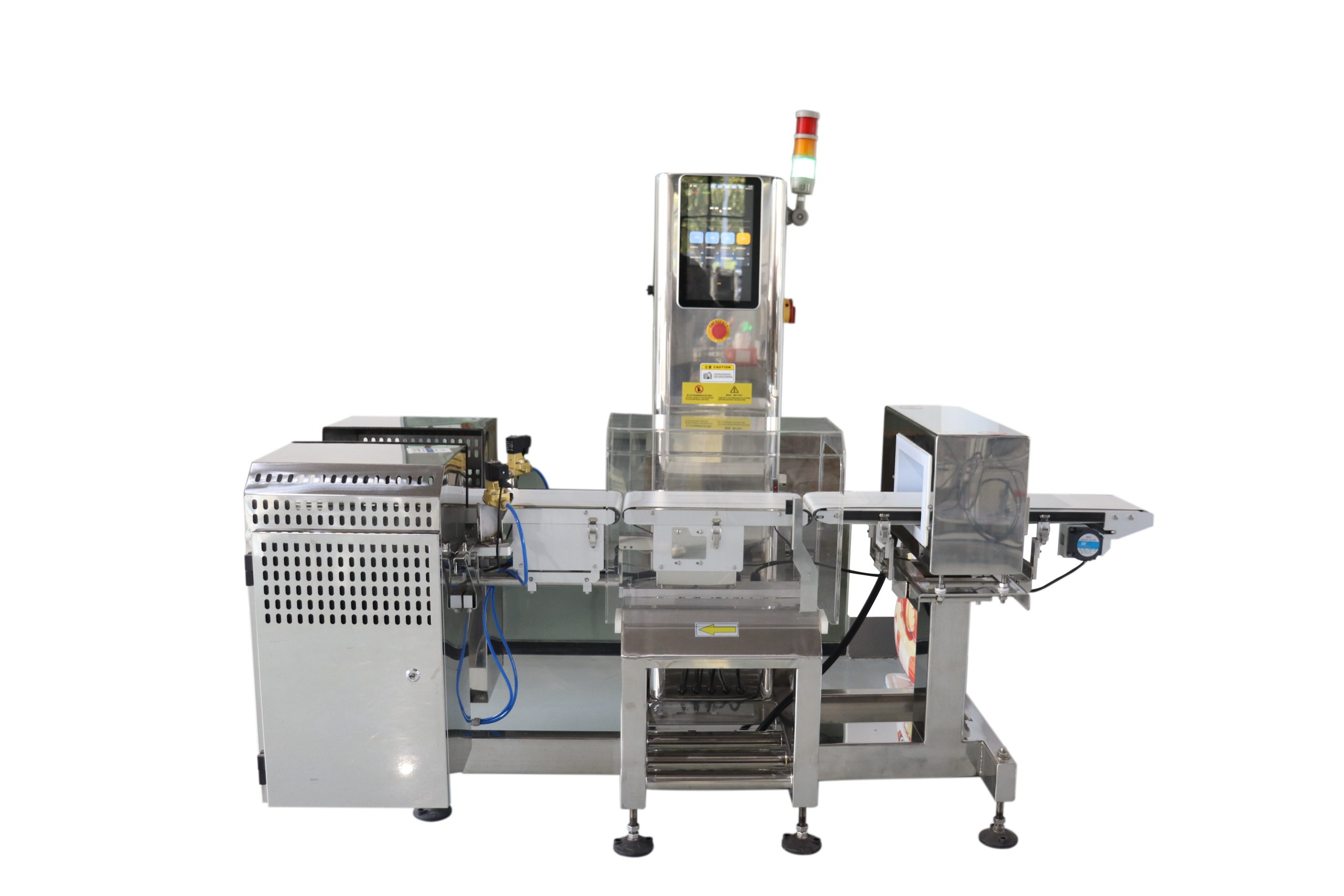
Dynamic Weight Quality Control for Continuous Production Lines
An online checkweigher, also called an in-motion checkweigher, measures and assesses the weight of individual products while they travel along the conveyor.
Target weights and upper/lower limits can be configured for different product recipes to help detect underfilled or overfilled packs, missing components and other weight-related anomalies.
The purpose of checkweighing goes beyond displaying a number: the weight result triggers an action. Acceptable products continue, while exceptions can raise alarms or be automatically rejected, with records retained as required.
Share Your Product DetailsFour Core Operations of an Online Checkweigher
Effective inline checkweighing combines weighing, decision-making, action and recording within the continuous production cycle.
Dynamic Weighing
Products move through the weighing conveyor, where the system captures their weights.
Weight Assessment
Check each weight against the active product recipe and its configured limits.
Exception Handling
Choose alarms, pushers, swing arms, air jets or other rejection mechanisms according to the product.
Data Recording
Record weights, counts and exceptions, with optional integration into host systems.
Typical Inline Checkweighing Process
Product Infeed
Maintain consistent spacing before the weighing section
Dynamic Weighing
Capture the current product weight
Weight Assessment
Compare with upper and lower recipe limits
Result Handling
Pass, alarm or automatically reject
Data Recording
Store weights and inspection results
What Problems Does Online Checkweighing Solve?
Underweight Detection
Detect packs below the configured weight range, helping identify underfilling or missing contents.
Overweight Detection
Identify products above the target range to support control of filling and packing operations.
Missing-Component Checks
Use weight differences to help identify missing items inside a pack.
Process Quality Control
Use weight as a quality metric and monitor shifts in the production process.
Upstream & Downstream Integration
Connect packaging, labelling, inspection, sorting and conveying into one process.
Production Data Recording
Store weights, quantities and exception results according to project requirements.
Why Can’t Weighing Accuracy Be Reduced to One Number?
Online checkweighing is a dynamic measurement. The product continues moving during weighing, so the results depend on the item and production conditions, not only on the load cell.
A more useful question than simply asking for accuracy is: What weighing performance can my product achieve at the required line speed?
Typical Technical Configuration
Online checkweighers are selected for a specific project. Weight range, display interval, dynamic weighing performance, throughput and rejection method must be confirmed for real products and conditions.
| Machine Type | Dynamic Online Checkweigher |
|---|---|
| Weighing Range | Select the appropriate range for the product specifications and weight classes. |
| Display Interval | Confirm against weighing range and configuration; display interval is not the same as dynamic weighing error. |
| Dynamic Weighing Performance | Verify with representative samples, taking account of weight, dimensions, centre of gravity, throughput, vibration and site conditions. |
| Target Throughput / Capacity | Assess product size, actual spacing, effective weighing time and inspection requirements together. |
| Conveyor Arrangement | Belt Conveyor with Dynamic Weighing |
| Product Recipes | Store and switch between multiple product configurations. |
| Weight Decisions | Acceptable, overweight, underweight and other project-specific conditions. |
| Rejection Methods | Pushers, air jets, swing arms and flaps, selected for the product. |
| Operator Interface | Industrial touch-screen interface, depending on the model. |
| Data Connectivity | Optional PLC, MES, database and production-system interfaces. |
Continue the Checkweigher Pre-Selection Process
Assess whether the equipment fits your actual product and production conditions, considering weight range, dynamic performance, throughput, dimensions, spacing, rejection and data interfaces.
Weight Data Can Also Become Part of the Production System
Checkweighing is not limited to a pass/fail result. Weight values can also be used by labelling, vision, inspection, rejection and supervisory software.
- Link with upstream and downstream conveyors
- Integrate with print-and-apply labelling
- Integrate with AI vision inspection
- Combine with metal detection / X-ray inspection
- Record weights and exception results
- Connect to MES, ERP or databases when required
Confirm Five Things Before Selecting a Checkweigher
Product
Dimensions, packaging format, base stability and conveying orientation.
Weight
Minimum and maximum weights, plus acceptance limits.
Throughput
Target rate, product size, spacing and continuous operating time.
Inspection Criteria
Required dynamic performance, permitted error and acceptance conditions.
Production Site
Conveyor height, available space, adjacent equipment and reject mechanism.
Once the product, weight range and throughput are known, review the full selection guide.
The guide explains weighing range, dynamic performance, throughput and spacing, rejection, data recording and acceptance boundaries so production, quality, engineering and purchasing teams can agree the requirements.
Frequently Asked Questions About Online Checkweighers
How does an online checkweigher differ from a static scale?
An online checkweigher captures and assesses weights while products move through the line, without an operator stopping and placing each item on a static scale. It is better suited to continuous automated quality control.
Why does checkweigher accuracy depend on more than the sensor?
Dynamic results are also affected by dimensions, centre of gravity, conveyor speed, spacing, vibration and packaging condition. Evaluate accuracy with the actual product at the intended throughput.
Can one checkweigher handle different products?
Depending on the machine and project configuration, multiple recipes can be stored and recalled with their respective weight limits, decision rules and conveying parameters.
Can a checkweigher connect to print-and-apply equipment or MES?
Depending on project requirements, it can exchange signals and data with PLCs, labelling equipment, AI vision, MES, databases and other systems.
Related Products and Technical Resources
Share Your Product Specifications to Start Checkweigher Selection
Product dimensions, weight range, throughput, permissible error and site conditions are the basis for selecting weighing range, conveyor structure, dynamic weighing performance and rejection.
提交您的项目需求
告诉我们应用场景与节拍要求,我们会在 1 个工作日内提供选型建议与方案参考。
 微信扫码咨询