
TECHNICAL RESOURCES
Technical Resources and Selection Guides
Start with products, weights, labels, production rates and inspection requirements
to assess equipment configurations early in a food manufacturing project.
Read selection guides online or download PDF technical resources
for production, engineering, purchasing and internal project discussions.
RESOURCE LIBRARY
Find resources by equipment type
Selection priorities differ by equipment type.
This page brings together online guidance, published specifications and PDF documents.
Online guides are available for the equipment categories below.
Weigh-Price Labeller
Use product weights, label width, rate and application position
to assess the weighing module, print engine and applicator,
then consider AI product recognition and label vision inspection.
Checkweigher
Assess weight range, pack dimensions, dynamic weighing,
rate, tolerance decisions, rejection and data recording.
Inline Print-and-Apply Labeller
Select the mechanism using label size, print width, resolution,
printing method, product surface, application position and rate.
Metal Detector
Use product characteristics, aperture dimensions, product effect,
detection sensitivity, conveying conditions and rejection method to define the inspection solution.
AI recognition and vision inspection
Understand pre-labelling recognition and automatic template selection,
and post-labelling verification of OCR text, codes, label position and content.
Quality Inspection Systems
Explore metal detection, X-ray inspection,
weight checks and the selection and combination of quality-inspection equipment.
FEATURED GUIDE
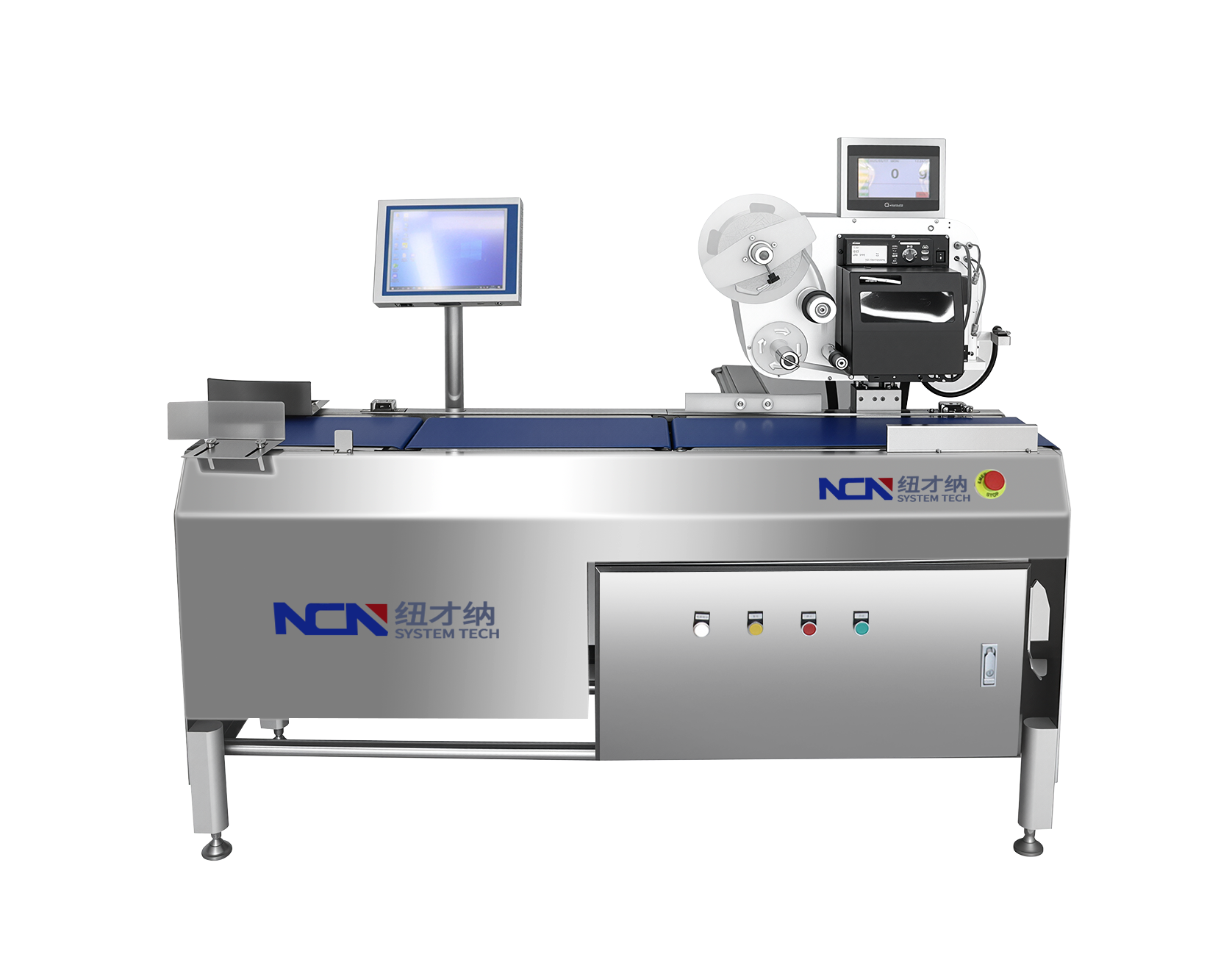
Weigh-Price Labeller Selection Guide
Weigh-price labelling requires more than combining a scale and a printer.
Product conveying, dynamic weighing, SKU confirmation, label-data generation,
real-time printing, automatic application and result verification must remain correctly matched.
- Select the weighing range for the minimum and maximum weights
- Select a 4-inch or 6-inch print engine according to the required printable width
- Choose the applicator for top, side, bottom or multiple labels
- Assess complete-machine throughput under stable continuous operation
- Consider pre-labelling AI recognition for multi-SKU production
- Consider post-labelling vision inspection where label errors present a significant risk
HOW TO SELECT
From project requirements to a formal equipment proposal
Online resources support preliminary assessment.
Before procurement, product and production conditions,
labels and acceptance requirements must be developed into a formal technical proposal.
Review selection guidance
Understand the conditions that determine configuration
Prepare product information
Dimensions, weights, labels, photos and production rate
Validate samples and the project
Use actual-product tests to confirm limits where needed
Confirm the technical proposal
Agree configuration, interfaces, performance and acceptance criteria
TECHNICAL NOTE
Use published resources for initial selection; validate against actual conditions
Food packaging equipment performance depends on the products,
environment, speed, conveying conditions and adjacent equipment.
Published parameter ranges therefore support initial technical assessment.
Dynamic weighing
Product weight, speed, vibration, stability and available weighing time all affect dynamic performance.
AI and vision
AI recognition and vision inspection require validation using actual products, similar products and boundary samples.
Production rate
Confirm capacity under stable continuous operation instead of comparing isolated parameters or theoretical maximum speed.
PROJECT SUPPORT
Cannot find a resource for your application?
Provide product photos or videos, dimensions and weight ranges,
sample labels, target rate, site layout and system-interface requirements
for further project assessment.
Founded in 2015, NCN Automation Technology (Shanghai) Co., Ltd.
focuses on food packaging end-of-line automation and intelligent applications.
Its scope covers weigh-price labelling, inline print-and-apply, checkweighing,
AI recognition and vision inspection, quality inspection, robotic labelling and production-data integration,
providing equipment, software and system integration for food manufacturers.
These resources support initial equipment assessment and selection.
Equipment configuration, technical parameters, interface scope, performance and acceptance criteria
are governed by the final technical proposal and agreement.
 微信扫码咨询