
AI Vision Quality Inspection SolutionsAutomatically identify, evaluate and record labelling results
For food packaging lines, AI vision can identify products and select templates before labelling, or verify label presence, quantity, position, OCR text, barcodes, QR codes and application condition afterwards. It coordinates with print-and-apply, exception handling and production-data systems.
Discuss Inspection Requirements Explore AI Vision Products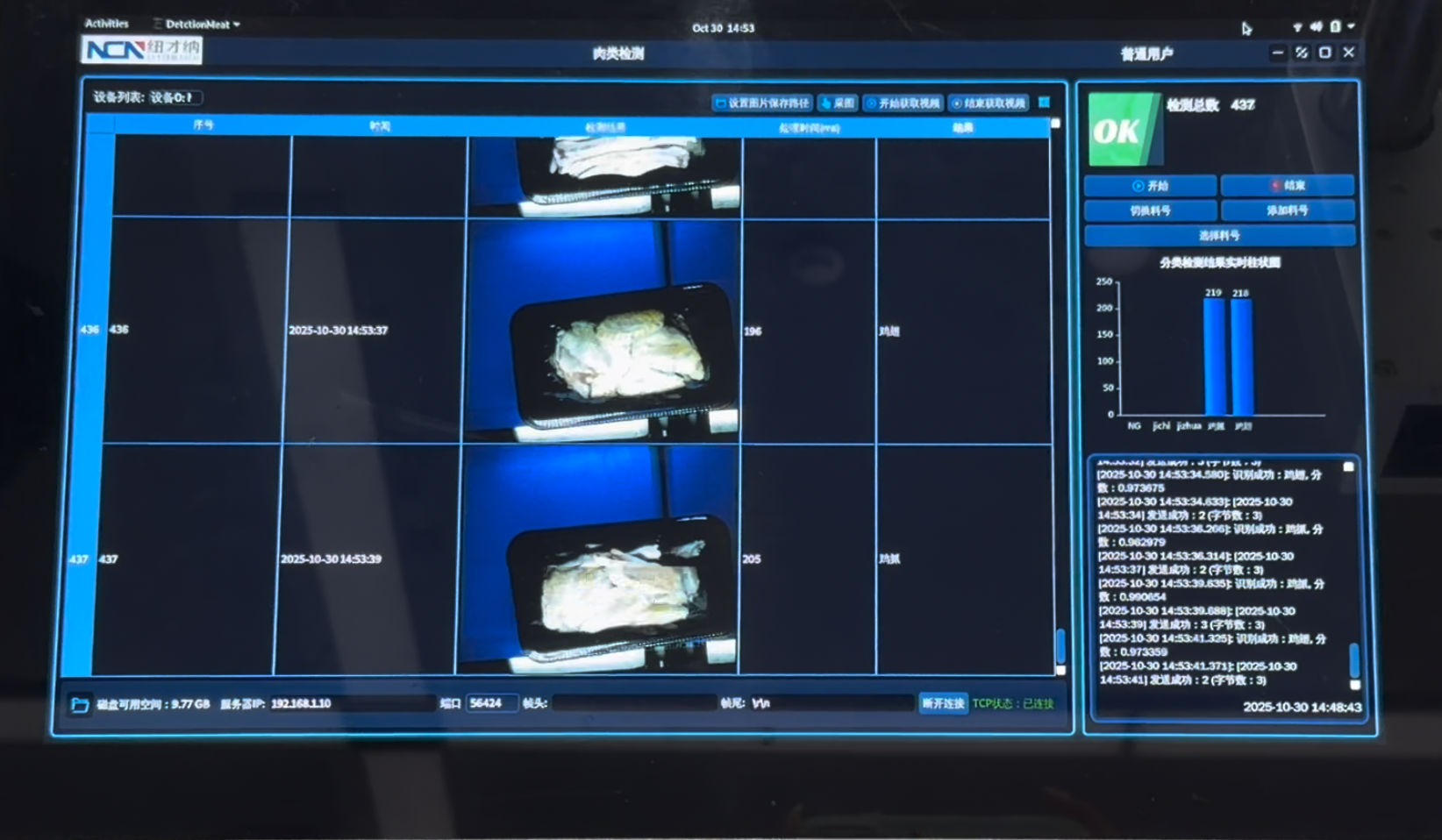
Determine whether the applied labels meet the requirements
Vision inspection in food packaging requires stable, repeatable evaluation of the labelling result against project requirements, beyond simply capturing an image.
A pack may carry product, weight and traceability labels or codes. The system must define which labels are required, the correct quantity, allowed positions, readable text and codes, and how failures should be handled.
From image acquisition to exception handling
Vision inspection is a complete workflow of triggering, recognition, evaluation, action and recording.
Configurable inspection functions
Select inspection items against the products, labels, camera view, production rate and acceptance criteria. Fixed accuracy claims require sample testing.
Check that the required label exists at the specified position.
Check that one, two or multiple labels are present as required.
Check for placement outside the allowed region or significant displacement.
Read dates, batches, product names and other text and compare them against defined rules.
Verify readability and compare encoded content where required.
Use product recognition or business data to confirm that the label belongs to the current product.
AI can identify products and select labels before application
For multiple SKUs or visually distinct products, AI vision can identify the product category, select its template, print and apply the label, and record product, label and equipment data.
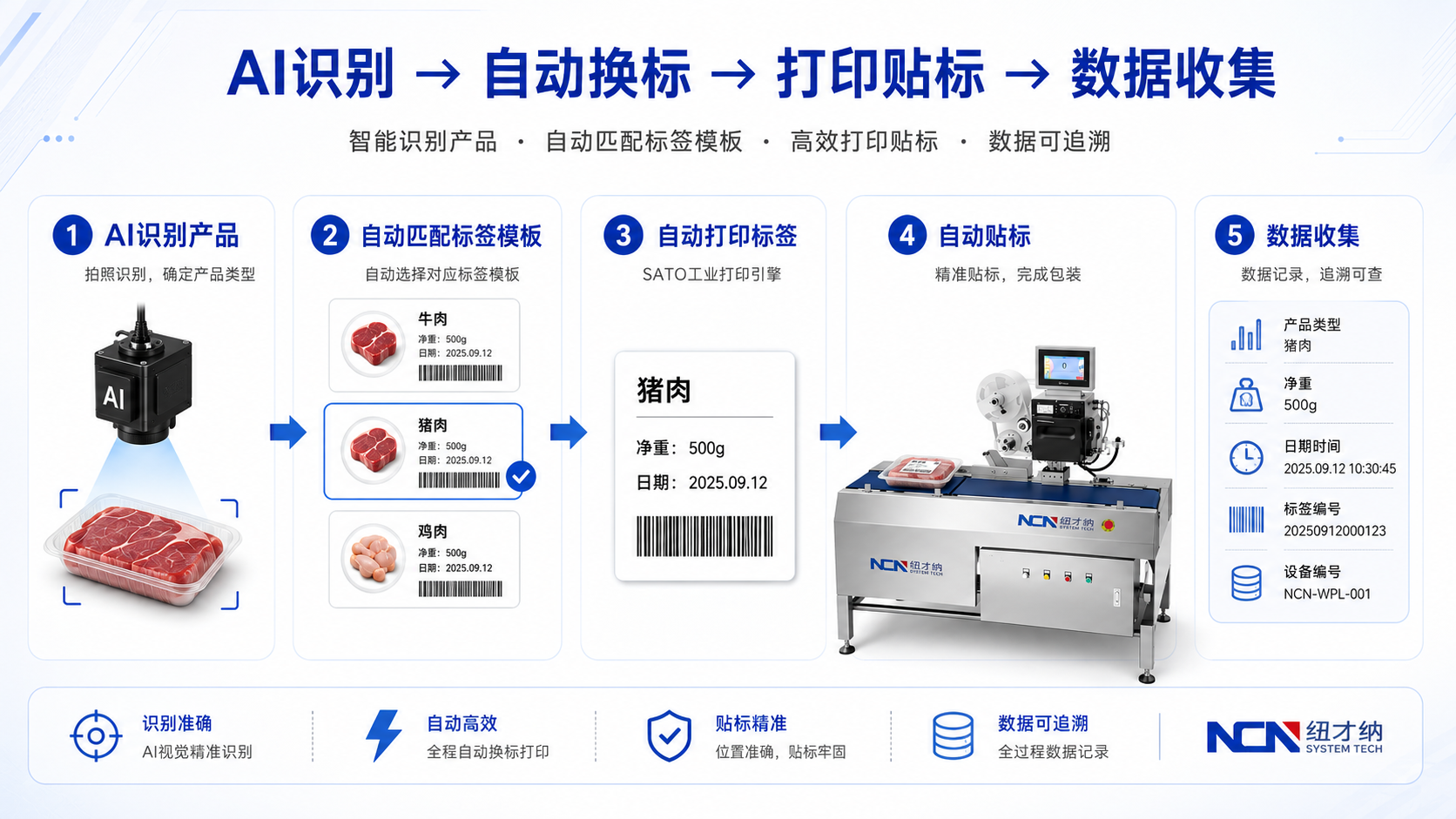
Workflow: AI product recognition → automatic template selection → label printing → automatic application → data collection. This pre-labelling recognition and data-driven workflow can be combined with post-labelling vision inspection to verify the final result.
Two distinct, connected AI stages before and after labelling
Pre-labelling recognition determines which product is present and which label it needs. Post-labelling inspection checks that the applied labels are correct, complete and correctly positioned. They can share product, label and order data while performing different technical tasks.
Identify the product category, select the correct template from master data or order rules, then proceed to print-and-apply.
Check label presence, quantity, position, OCR text and codes, then trigger an alarm, rejection or recording for nonconforming products.
Integrate vision into a weigh-price labelling line
AI vision can operate as an independent inspection unit or connect with upstream recognition, weigh-price labelling and inline print-and-apply. The workflow links product recognition → template selection → printing and application → automatic verification → exception handling → data recording.
- Share production-order or label data with the print-and-apply equipment.
- Automatically inspect label presence, quantity, position and content after application.
- Output failed inspection results to the PLC for alarms, rejection or line stops.
- Record inspection results, images or exception history within the agreed project scope.
- For MES/ERP integration, define interfaces for products, orders, inspection results and exception data.
Typical applications
Confirm weight-label presence, correct quantity and barcode readability.
Check top, side or multiple labels for presence and relative positioning.
Use AI to recognise different products and verify matching templates or label content.
Associate inspection results with batch, order or product data.
Optional extensions
Combine vision with other inspection and data modules according to the site’s quality-control requirements.
Why sample testing comes first
AI vision performance depends on product appearance, reflections, label materials, lighting, camera angles, inspection requirements, sample quantity and production rate. Confirm the inspection scope with representative samples before the formal project.
- Define the inspection items and what constitutes a defect.
- Provide acceptable products and representative defect samples.
- Confirm production rate, camera installation space and viewing angles.
- Agree acceptable false-reject and missed-defect rates and exception handling.
- Document the final acceptance test method in the technical agreement.
Information for project assessment
Different SKUs, packaging materials, colours and surface conditions.
Dimensions, content, positions, codes and OCR fields.
Representative missing, wrong, insufficient, misaligned or incorrectly printed labels.
Rate, conveying method, space, ambient lighting and upstream/downstream interfaces.
Frequently asked questions
AI product recognition and AI quality inspection: are they the same?
These are different tasks. AI product recognition identifies the current product and selects the appropriate template or production order. Post-labelling vision inspection checks that the right labels are present, complete and correctly positioned. Both can work together on one line.
AI quality inspection: what can it check?
Project-specific checks can include presence, quantity, position, orientation, OCR text, barcode/QR-code readability and aspects of label application condition.
AI vision inspection: can it connect to a labeller?
Yes. A vision station after application can verify labels and connect to rejection, alarms, data recording or a host system.
AI recognition accuracy: can a fixed figure be guaranteed?
A fixed accuracy figure should not be promised independently of the products. Establish formal targets through representative sample tests and an agreed acceptance method.
Related products and content
Define the inspection task before discussing AI accuracy
Provide product samples, labels, defect types and the target rate to assess cameras, lighting, algorithms and acceptance tests.
提交您的项目需求
告诉我们应用场景与节拍要求,我们会在 1 个工作日内提供选型建议与方案参考。
 微信扫码咨询