
NCN AUTOMATION · SOLUTIONS
AI Recognition & Weigh-Price Labelling Solution
Identify each product before dynamically weighing it and printing the correct label. AI recognition results can drive SKU matching and automatic template selection after sample-based validation.
Discuss Your Application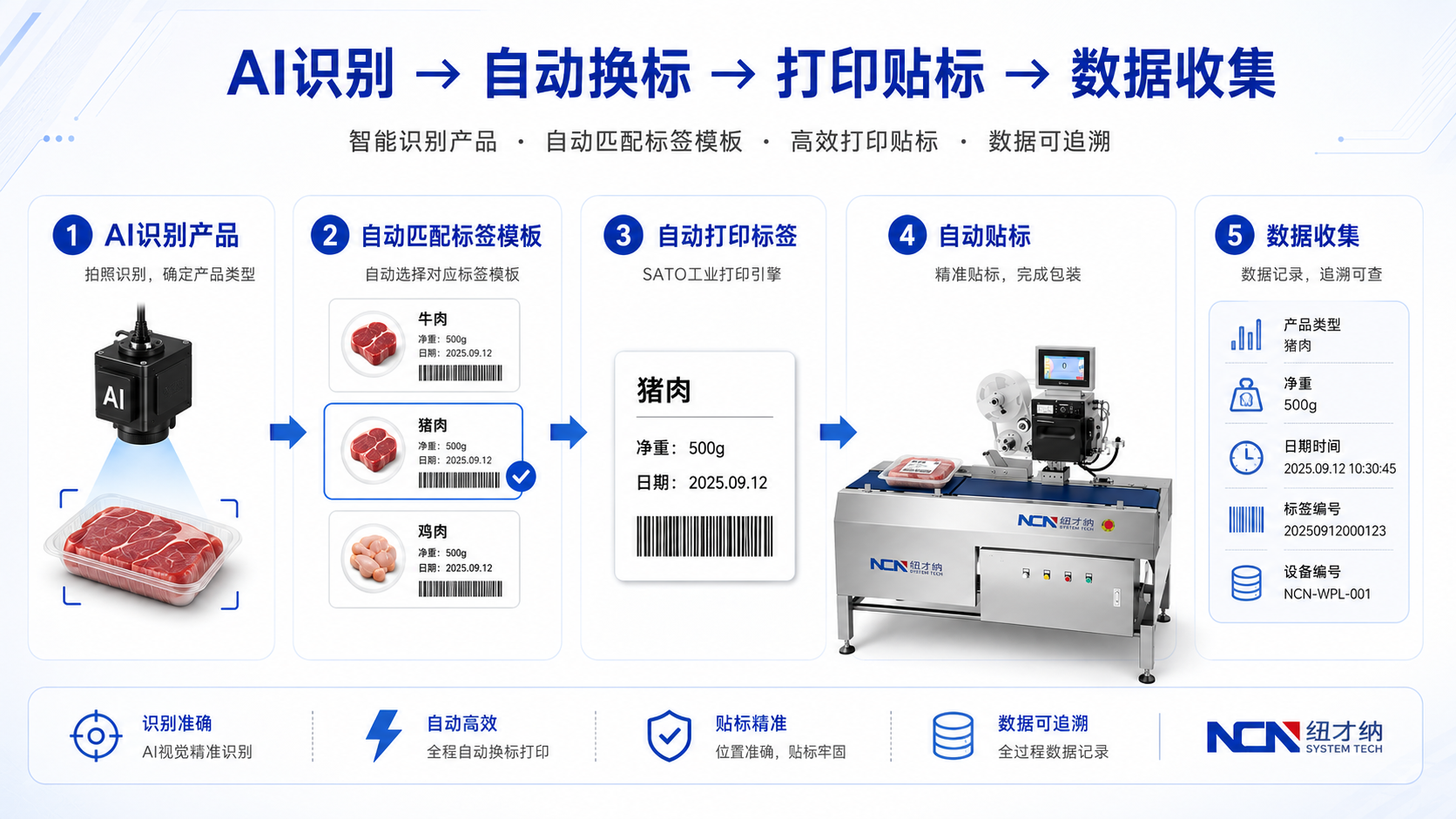
Process Overview
System Capabilities
AI identification
Classify suitable product and packaging variants using a validated recognition model.
Label template selection
Map confirmed SKU to approved label data and template.
Dynamic weighing
Capture real pack weight for variable-label printing.
Exception management
Define rejection or manual review for uncertain recognition.
Optional inspection
Check applied labels and codes with downstream vision equipment.
Production data
Connect relevant records to customer systems as specified.
Project Requirements
Provide representative products, label designs, SKU list, expected speed, pack dimensions, layout and any data interface requirements. Throughput and technical feasibility must be verified with samples and project specifications.
Frequently Asked Questions
Will it automatically change labels?
Yes when product identification and mapping rules are verified.
Is label inspection included?
It is a separate optional stage.
Is accuracy guaranteed for any SKU?
No. Confirm recognition reliability with samples and site conditions.
What Happens After AI Identifies the Product?
The objective is not simply to display a classification result. A valid recognition result must be associated with the correct product master record, label template, variable fields and weighing rules. Each moving pack needs to remain associated with its own recognition and weight data through printing and application.
SKU and template mapping
Assign a unique or explicitly approved SKU and label template after identification. Missing or conflicting matches must be handled as exceptions.
Dynamic data association
Link measured weight to the same tracked product and combine it with date, lot, barcode or price fields supplied by the appropriate production data source.
Uncertain results
When confidence is below the validated threshold or the template cannot be found, define a hold, alarm, rejection or operator-confirmation procedure rather than guessing the label.
From Product Recognition to Label Quality Control
Pre-labelling recognition and post-labelling verification solve different problems. The first determines which product and template should be used; the second checks the actual printing and application result.
Before labelling
Identify product appearance and relate the result to approved product and template rules.
After labelling (optional)
Verify label presence, position, required text or barcode readability as specified.
Production records
Store relevant recognition results, weight records, label tasks and alarms according to the project data model.
Validation Before Deployment
Confirm the full SKU list, visually similar products, package and film variations, lighting, required throughput, label format and acceptance criteria. Run representative sample trials across expected operating conditions. New products or significant packaging changes may require additional image collection, model updates and revalidation.
Recognition rate, label accuracy and total line capacity are project-dependent. They must be established through agreed test conditions, not inferred from an AI camera specification alone.
Discuss your production line
Contact NCN Engineers提交您的项目需求
告诉我们应用场景与节拍要求,我们会在 1 个工作日内提供选型建议与方案参考。
 微信扫码咨询