
Huai’an Frozen Food Factory: Tray Sealing and Inline Print-and-Apply
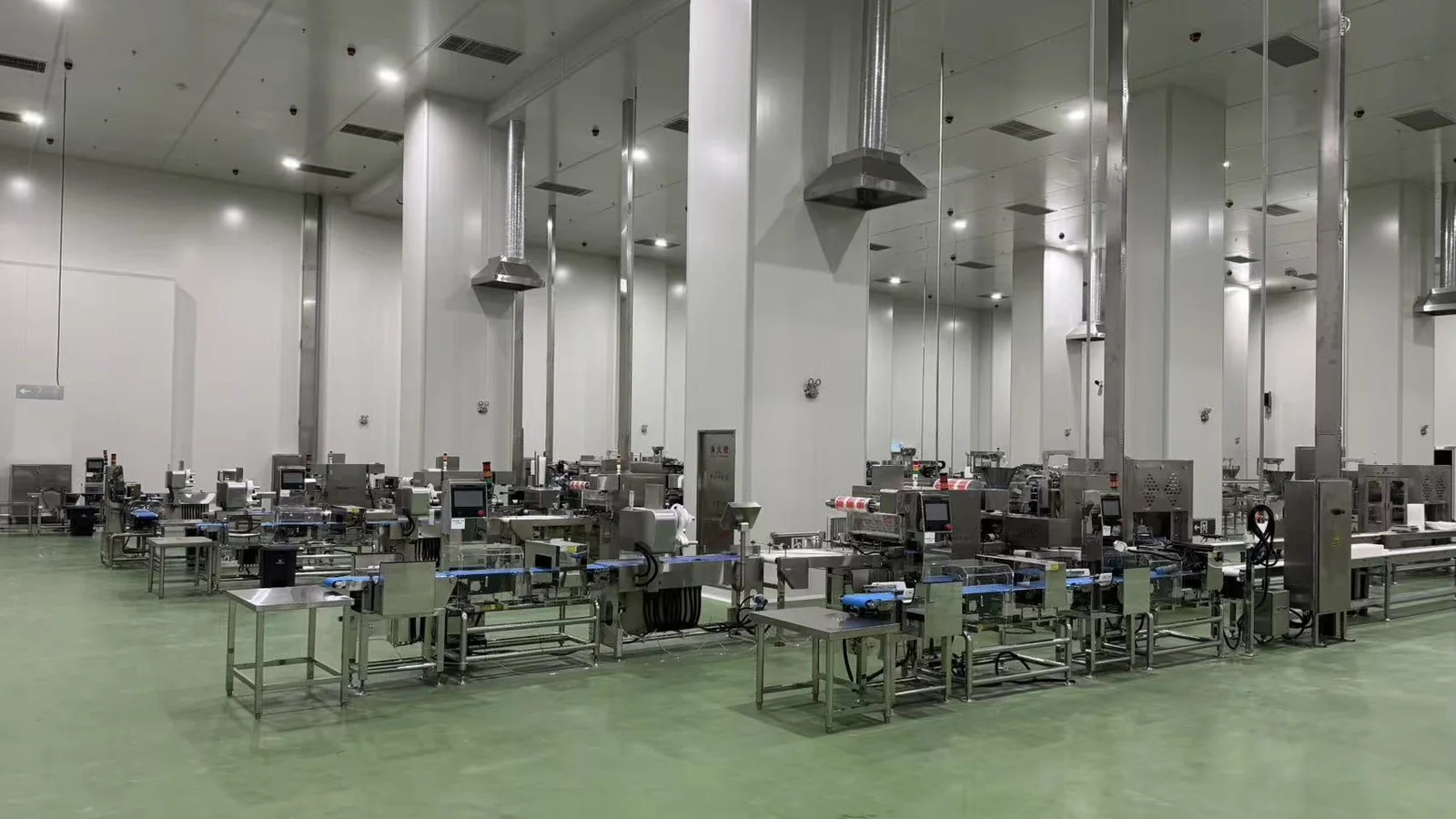
Tray sealing, outfeed conveying and inline print-and-apply equipment are now in production at a frozen food workshop in Huai’an, Jiangsu. For products such as tray-packed wontons, the customer needs sealed trays to transfer smoothly to the next station, labelling to keep pace with the upstream process, and equipment arranged side by side to remain accessible for daily operation.
What Needs to Happen After the Tray Is Sealed?
After film sealing, tray-packed wontons still need to be conveyed, have labels printed and receive those labels automatically. Overall performance depends on more than labeller speed: upstream outfeed direction, product spacing, conveyor transfers and label position also matter. Where several machines share the same area, film changes, label changes and inspection access must be considered together.
Stable Tray Outfeed
Trays leave the sealing station in the defined direction and enter the next conveyor, reducing skewing, accumulation and unnecessary waiting.
Matching the Labelling Cycle
Product arrival, label generation and application must be coordinated. A print engine’s maximum print speed alone does not establish complete-line throughput.
Maintenance Access
Leave space for roll changes, cleaning, servicing and personnel access when multiple machines operate together.
Connecting Tray Sealing with Inline Print-and-Apply
Film sealing, tray outfeed and print-and-apply were considered as parts of one production flow. Sealed trays travel to the labelling position, where product-arrival signals trigger the required printing and application sequence before the trays proceed downstream.
These are the main processes covered by this case. The final infeed method, application position and upstream/downstream equipment interfaces depend on the agreed site layout and commissioning conditions.
Video from the Production Site
This recording shows the actual project site and the connection between film sealing, tray outfeed and the downstream print-and-apply station. It allows customers to observe station spacing, conveyor direction and coordinated movements in a working line.
What Requirements Were Set During Equipment Selection?
The following requirements are useful references for food businesses planning a similar line. They come from the project’s initial technical requirements and were used as design and configuration inputs. They must not be treated as measured production results.
- Reference Tray Dimensions
- 195 × 125 × 33/38 mm.
- Design Throughput Requirement
- For the reference tray under standard sealing conditions, the initial project target was at least 4,000 trays per hour. This does not mean that a single labeller was measured at that speed.
- Inline Print-and-Apply
- The initial requirements included variable printing of Chinese text, barcodes and QR codes, with label content updated from order data.
- Labels and Station Coordination
- The print-and-apply cycle must match the sealing machine’s tray outfeed. Label dimensions, print content and application position are confirmed for the specific configuration.
- Provision for Modified Atmosphere Packaging
- The original requirements called for structural provision for a future MAP upgrade. This does not establish that modified atmosphere packaging is already in use at the site.
What Can Be Learned from the Operating Project?
The equipment has been installed, commissioned and put into production. The practical lesson is that the sealing machine, conveyor sections and print-and-apply station need to be planned around the same production cycle and available space. Similar tray-packed food lines still require an assessment of the actual trays, sealing method, sample labels and target output before equipment selection.
Site photographs and operating footage document the equipment layout and operating condition. Long-term sustainable output, causes of downtime and actual yield require operating records; this case does not estimate those figures.
Questions to Confirm When Planning a Similar Line
These are common technical questions when combining tray sealing with inline print-and-apply. Outfeed arrangements and available space differ between lines, so another factory’s configuration cannot simply be copied.
Can Print-and-Apply Be Added to an Existing Tray Sealer?
A retrofit can be assessed without necessarily replacing the upstream machine. First confirm outfeed direction, continuous cycle rate, product spacing and available space. If trays do not reach the labelling position at consistent intervals, additional transfer conveying, guides or spacing mechanisms may be required.
Can One Labeller Handle Several Tray Sizes?
Start with the largest and smallest tray dimensions and confirm whether the label position is the same. If sizes are within the equipment’s adjustment range, guide and parameter changes can be assessed. Larger variations require checks of conveyor support, positioning and the application movement. Trials with both size extremes are advisable.
Can Dates, Batches, Barcodes and QR Codes Be Printed from Production Orders?
The initial requirements for this project included variable printing of Chinese text, barcodes and QR codes, with updates from order data. For a new line, first confirm the data source, template-selection method and handling of network or scan failures, then carry out interface and sample-print tests. This case does not establish that every possible system interface was implemented at the site.
Is 4,000 Trays per Hour a Measured Production Result?
No measured output of that level is published here. The figure comes from the initial design requirement for the reference tray under standard sealing conditions. Actual continuous throughput also depends on tray dimensions, sealing cycle, product spacing, label content and site test records.
Is This Line Already Using Modified Atmosphere Packaging?
The available information confirms only that the initial requirements called for structural provision for a future MAP upgrade. It does not establish that MAP was in use when production started. A new MAP project needs separate agreement on gas introduction, packaging materials, sealing requirements and validation conditions.
Adding Automatic Print-and-Apply to a Tray-Sealing Line?
Send tray dimensions, target line rate, sample labels and the site layout so we can assess station interfaces and equipment configuration.
 微信扫码咨询