
Why Consider V-Type Weigh-Price Labelling for Long, Round and Roll-Prone Products?
In many vegetable-packaging projects, the main challenge is keeping products stable as they pass through the weighing and labelling stations. V-shaped conveying addresses product orientation and lateral stability.
In vegetable packaging, produce processing and some irregular food-packaging applications, weighing and label application are often not the most difficult operations.
An easily overlooked question is whether products can pass stably through the weighing and labelling stations.
Flat belts usually provide stable transport for boxes and trays. Conditions change when products are elongated, cylindrical or nearly spherical, when film is slippery, or when the centre of gravity is unstable.
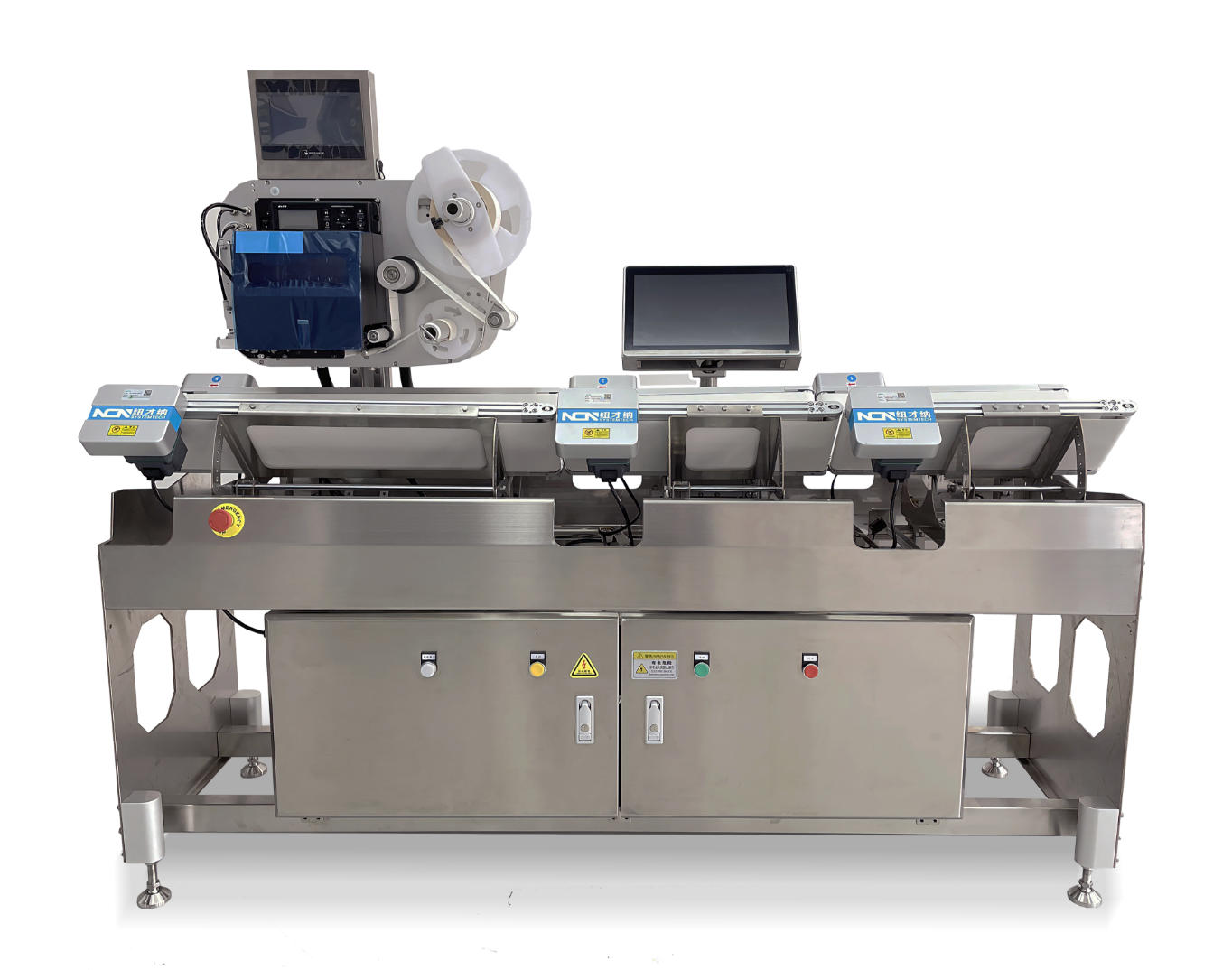
NCN V-type weigh-price labeller: V-shaped guidance improves the transport orientation of vegetables and certain long, cylindrical or roll-prone packs.
Why may a flat belt be unsuitable for roll-prone products?
Flat belts are simple and versatile but offer limited lateral restraint. Flat-bottomed packs usually travel well; some round, elongated or flexible packs, and products with a shifting centre of gravity, may move sideways, roll, rotate or change direction during continuous transport.
These conveying issues also affect downstream processes. Dynamic weighing requires stable passage through the weighing section, while print-and-apply needs a reasonably predictable product orientation at the application point.
V-shaped conveying: guidance and lateral stability
V-shaped conveying uses two inclined surfaces to guide the product. For certain elongated, cylindrical or roll-prone packs, it reduces unrestricted lateral movement and helps maintain a more stable orientation through weighing, printing and labelling.
Not every vegetable requires V-shaped conveying. Shape, packaging materials, friction, centre of gravity and seal formats vary considerably. This structure is most relevant where a flat belt cannot reliably control the pack; suitability still requires actual-product testing.
Why combine V-shaped conveying with dynamic weighing?
Vegetable packs often vary in weight. When net weight, unit price, total price, batch or traceability information changes for every pack, weighing results, label data and application must stay connected.
NCN’s existing V-type solution follows this sequence. After guidance and dynamic weighing, the system acquires each pack’s weight, retrieves its product data and template, generates the label in real time and applies it automatically.
Alongside reducing manual work, the system aims to keep each product, weight, label and application operation correctly matched.
What can operating videos show?
NCN equipment videos show packed vegetables entering continuously and passing through guidance, weighing, printing and application. The key observation is whether products travel steadily without repeated manual repositioning, rather than the motion of an individual actuator.
This matters on an automated line: persistent upstream product movement limits how effectively downstream weighing and application components can perform.
Which products warrant consideration of V-shaped conveying?
Some cucumbers, carrots and similar long products may change orientation on a flat belt.
Products that naturally roll are harder to control laterally when packaging surfaces are slippery.
Movement inside a bag can shift its centre of gravity and affect its transport orientation.
When weight goes directly onto the label, transport stability affects both weighing and product-data matching.
V-shaped conveying is also used by established international suppliers
V-shaped conveying is not exclusive to one manufacturer. Bizerba’s published GLM-Ievo 100V material describes a V-shaped conveyor for stable, gentle transport and labelling of round, spherical and irregular products.
This public product reference illustrates an established engineering approach in weigh-price labelling. It does not imply that different manufacturers offer identical specifications, designs or application limits.
View Bizerba’s official product brochure →Compare how the complete system coordinates guidance, dynamic weighing, label generation, print-and-apply and data control, rather than simply whether it has a V-shaped belt.
V-shaped conveying has limits: test samples before relying on specifications
Vegetable products differ in size, centre of gravity, film friction and seals. Some run stably on flat belts, others benefit from V-shaped guidance, and others need additional orientation, restraint or another conveyor design.
A machine structure should not be selected solely from photos or product names. Dynamic tests with actual samples provide a sounder basis.
- Include minimum, typical and maximum pack sizes.
- Include the lightest and heaviest products.
- Prioritise packs most likely to roll or shift.
- Check weighing settling time, label content and application position together.
- Run continuously at the target rate, rather than testing only individual packs.
What should you assess when selecting a V-type weigh-price labeller?
1. Is a V-shaped structure suitable for the product?
Start here. An unsuitable structure creates greater problems than a modest difference in rated speed.
2. Are weighing and conveying coordinated?
Product settling time, conveyor cycle, weigh-section length and weight-acquisition logic must work together.
3. Is label data generated in real time?
If weight, batch or date varies, the system must correctly match each pack to its label content.
4. Is the application position consistent?
Labelling consistency depends on product orientation, transport stability, label dimensions and applicator design.
5. SKU changeover efficiency
Vegetable packaging often involves many SKUs and seasonal changes, making efficient retrieval of product parameters and templates important.
6. Are data connections required?
With MES, ERP, scanning or traceability requirements, the equipment must participate in the production-data workflow.
Choosing the right structure
V-type weigh-price labelling addresses stable transport as a foundation for weighing and labelling. It establishes a steadier product orientation, then links dynamic weight, label data, real-time printing and automatic application.
This approach merits assessment for vegetables and certain elongated, cylindrical, roll-prone or irregular packs. The final choice must be based on the actual products.
Need to assess whether your product suits V-shaped conveying?
Provide product photos, representative samples, weight ranges, labels and the target rate to evaluate transport stability, weighing response and application position.
Explore the V-Type Weigh-Price Labeller 微信扫码咨询