
AI Recognition and Weigh-Price Labelling SolutionsIdentify the product, then automatically select its label
For multi-SKU, mixed-product and variable-weight food packaging, AI vision identifies the product category and the system selects its template. Dynamic weighing, real-time printing, automatic application and data collection follow, reducing manual decisions and template changes.
Discuss Sample Testing Explore AI Vision Products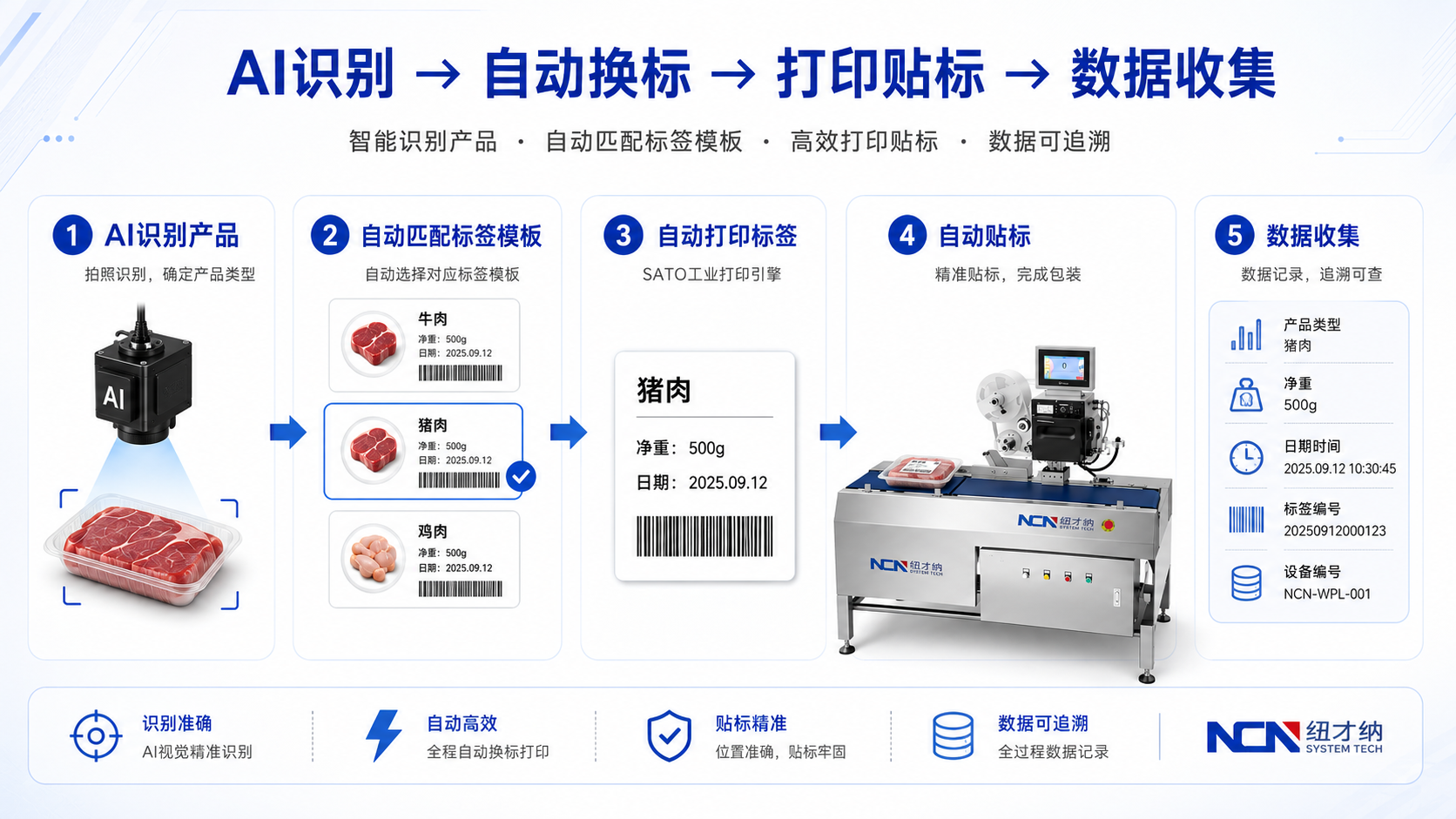
Use recognition results to control subsequent production operations
In multi-SKU or mixed production, manually identifying the product, selecting a template and starting print-and-apply can lead to mismatches between the product and label.
AI recognition and weigh-price labelling uses the recognition result to trigger subsequent operations: retrieve product information and the corresponding template, then weigh, print, apply the label and record data.
The complete workflow from AI recognition to data collection
Recognition is the starting point. Product identification, template selection, weighing, printing, application and data recording must stay connected.
Define what happens after recognition
AI models alone do not complete the automation. Recognition results must connect to master data, templates, weighing rules and exception logic.
Core capabilities
Build recognition models for the project’s defined product categories and confirm performance through sample testing.
Retrieve the corresponding template after recognition to reduce manual selection errors.
Use real-time weights to generate labels and records for variable-weight products.
Generate labels for the current product and order, then apply them automatically during continuous production.
Record product category, weight, label, timestamp and equipment information as specified.
Connect MES, ERP, scanning, vision verification or other business systems according to project requirements.
Typical applications
Automatically identify meat categories or SKUs and select the corresponding templates.
Put each product’s actual weight directly onto its label.
Reduce manual product and template selection during frequent changeovers.
Record product categories, weights, label identifiers and equipment-execution information.
Add post-labelling quality verification
Pre-labelling recognition determines the product and label required. Post-labelling vision verifies the result. The two stages can work together.
First verify that products can be reliably distinguished
AI recognition depends on appearance differences, packaging reflections, orientation, lighting, camera angle, sample quantity and production rate. Fixed accuracy claims require representative sample testing.
- Provide all product categories and representative SKUs to distinguish.
- Cover normal appearance variation, batches, packaging and orientations.
- Define when manual confirmation is allowed and how unrecognised products are handled.
- Confirm mappings between templates, weighing rules and product master data.
- Run continuous tests with representative samples at the actual production rate.
Information for project assessment
All required categories, SKUs and typical appearance variations.
Layouts, variable fields and barcode rules for each product.
Weighing range, price calculation, fixed-weight requirements and allowed deviations.
Mixed-product flow, target rate, adjacent equipment and exception-handling requirements.
Frequently asked questions
AI recognition and weigh-price labelling: what does it solve?
It identifies products on multi-SKU or mixed-product lines, automatically selects the correct label template, and continues through dynamic weighing, print-and-apply and data recording.
AI recognition: can it switch label templates automatically?
Yes. Recognition results can retrieve the corresponding product master data and label template. Matching rules, exception handling and interfaces must be agreed for the project.
AI recognition and AI quality inspection: what is the difference?
AI recognition determines which product is present and which label it needs. AI quality inspection checks that the applied labels are correct, complete and correctly positioned. Both can be combined on the same line.
Related products and case studies
Verify reliable recognition before defining automatic template changes
Provide product photos, representative samples, templates, weight ranges and the target rate to assess the recognition model, template mapping and weigh-price labelling workflow.
提交您的项目需求
告诉我们应用场景与节拍要求,我们会在 1 个工作日内提供选型建议与方案参考。
 微信扫码咨询